Creator
Status
Health has been declining since the 20s.
It started with common brain injury symptoms. Head pain, fatigue, dizziness, lightheadedness, brain fog, nausea, sensitivity to light / noises and executive function struggles.
Next came behavioral issues and personality changes. Depression, irritability, loss of motivation, anxiety, emotional instability, aggression, erratic and impulsive behaviors, lack of interest, self-isolation, mania, high sensitivity, low discipline, uncontrolled crying, paranoia, explosive outbursts, apathy and suicidal ideation.
Now the speech is gone. I can make noises. But I can’t say words and conversate. Movement and walking have also become difficult.
Diffusion Tensor Imaging identified brain degeneration. There’s loss of white matter and neurons along with thinning of the corpus callosum. Concussions, traumatic brain injuries, behavioral disorders and executive function decline were noted throughout testing as well.
Adversity.
This can lead to reflection. A search for answers.
Meanwhile, there has always been belief in a higher power. It has been difficult to make sense of though. So, I reflect, search, study and write. Then remain open minded to learn while doing my best to maintain faith.
That’s one reason for the creation of Heart & Lead. It’s a place to document efforts and share learnings. It also keeps me accountable to displaying positive behaviors. Most importantly, it conditions the mind to generate the strength required to work through the adversity.
A part of this process involves the practice of faith. This is backed with a commitment to the study of history, religion and spirituality. The purpose being to gain a greater understanding of adversity and life. It also comes with hope that it will strengthen my relationship with God.
That’s where the challenge comes into play.
Study
My belief in God weakens when studying history and religion. I then get frustrated, lose faith and feel less connected to God. Yet I still want to believe. So I remain open minded, committed to study and practice along with doing my best to maintain faith.
A part of these study efforts include books and movies. Some of which are included below.
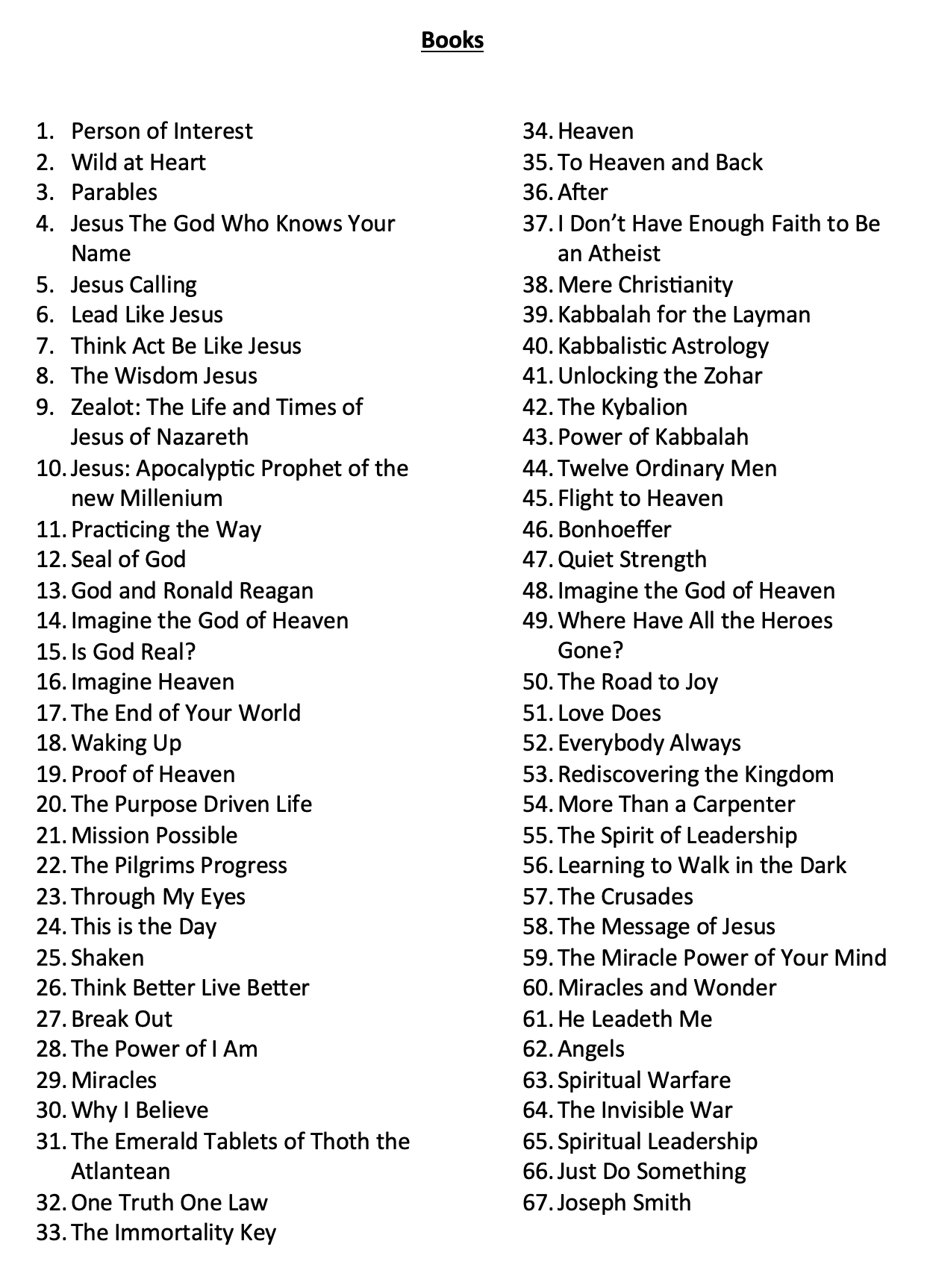
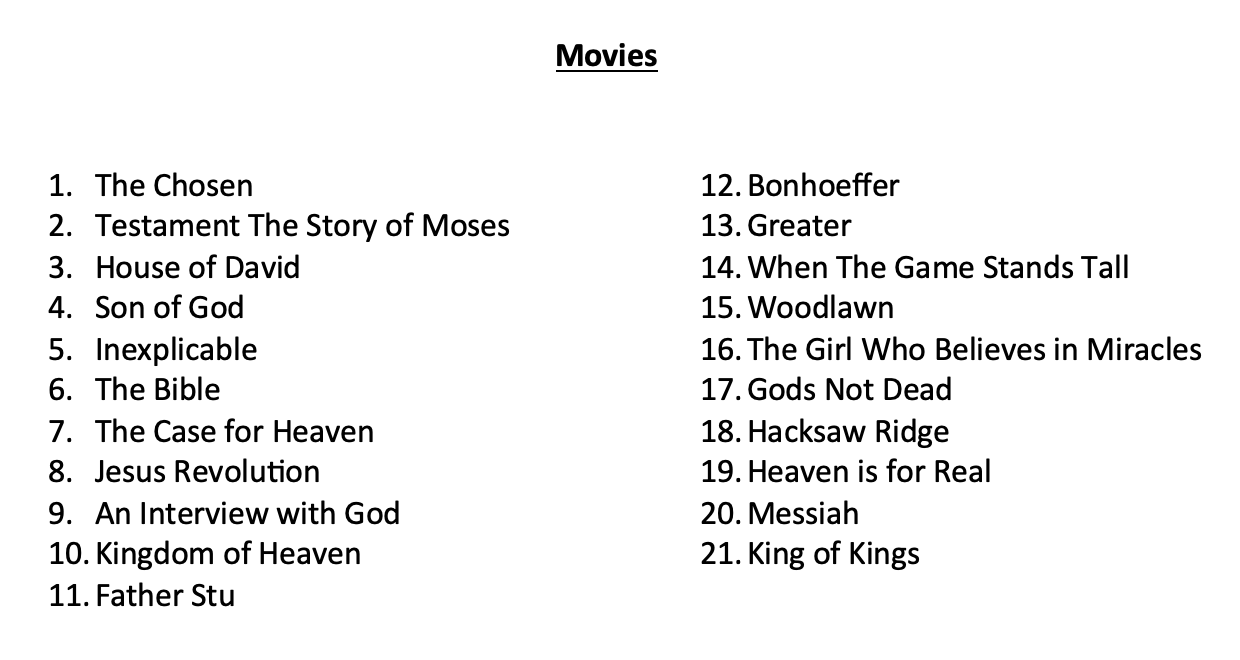
I’ve also attempted to complete the Bible. Several times. Then there’s all the podcasts, videos and articles that focus on religion and involve practices like Bible Study that have been completed over the years. These efforts led to the same results. Frustration, doubt then distance from God. This bothers me. I study with the hope that it will draw me closer to God. Not push me father away. That’s why I haven’t been interested in completing the Bible. The process of doing so only drives me farther away from something I want to be close to.
This challenge does not come down to a lack of commitment either. I’ve been completing several hundred books a year for 17 years (1,015 in 2020). Along with thousands of podcast episodes. To achieve these results requires a commitment of several hours a day, every day, just devoted to study.
Point being, when reflecting on actions, it’s clear how much I want to believe in religion and its teachings like the Bible. That’s why I remain committed to invest the time to study and stay open minded. It’s also one reason for writing this post.
Learning
Drafting began a while back.
The initial outline was 11 pages. It summarized religious events, practices, teachings and stories I struggled to make sense of. Then I found myself with more questions, concerns and doubts about religion.
When this happened I thought my efforts were taking me in the wrong direction. My fault. So I stopped. Put the post on hold. I had to reset my perspective. In doing so, I realized that these efforts were not a waste. They proved to be beneficial in helping understand my current thoughts and position. These will be shared in the last section, Belief.
For now I’m working to get a better sense for why I feel disconnected to God and lose faith when studying religion. Story, Culture and Existence are three factors for why this may be.
Story
Noah’s Ark
From my understanding, God saw evil throughout the world. This led him to creating the flood. He saved Noah, his family and several animals. The reason being that they were considered righteous and remained faithful in their commitment to God.
This is where I get in my head. There’s difficulty making connections.
When studying religion common phrases are shared. Some of which include: God is good, God doesn’t make mistakes and God made us in his image. Religious experts and leaders also claim that God has unlimited power. Then there are those who believe that God a specific plan for Earth and every person given his knowledge of the past, present and future.
I like these concepts. If leveraged appropriately they can generate faith and do good. However, if they are true, I struggle to understand them. For example, if God is good, has unlimited power, doesn’t make mistakes and knows the future then why did he create the flood? Something that is good wouldn’t intentionally kill almost all life on Earth. Something that has unlimited power would have the ability to convert people from evil to good. Something that doesn’t make mistakes wouldn’t need to create a mass death event to allow for a new start. Something that knows the future must have then known that they would need to kill everything they created then did so willingly.
This isn’t the only story about God taking lives of his creations either. There are several shared throughout the Bible. All position God as someone who uses his powers to harm and kill.
Then there’s the concept of Free Will. If God is good and all powerful then why does he allow bad things to happen to good people? The response given frequently is Free Will. I like this concept too. In most situations it makes sense. However, if Noah’s Flood along with many other religious stories are true then the concept of Free Will does not apply. Or it does until God decides to impose his own will. So, what is it? Free Will, Gods Plan, both or something else?
It’s difficult to make sense of. God is supposed to have infinite capabilities and be omniscient. If true, he could have prevented the situation on Earth from getting to a point where he had to destroy everything he created and start over.
Then there are questions about the event. The ones that come to mind involve building the ark, guiding the animals and creating the flood. All can be difficult to make sense of.
Most my focus of these studies has been the moral component though.
Was everyone in the world evil and worth killing? What about newborns and kids? Were all the animals evil? Were they not worthy of being saved? God had the capability to speak with Noah, provide direction on how to build the ark, guide animals from around the world to get there, followed by creating a flood so destructive that it killed everything on Earth. Yet he was he not able to use these same capabilities and unlimited power to guide his creations back to being good? According to the Bible, he showed this capability with Mary Magdalene (and her seven demons) along with many others. Why not in this situation?
Last I consider what happened after this event. Stories like how Noah became a farmer and planted a vineyard. Then got drunk and passed out naked. His son Ham saw it then went to tell his brothers. When Noah woke he learned how Ham handled this situation. Then he cursed him and declared that his son would be a servant to his brothers. Getting drunk to the point of passing out naked, treating your son poorly, then making your grandson a servant (which may mean slave) because of it is not positive behavior. It’s not righteous behavior either. Religion also positions Noah as someone who is supposed to be the best of humanity. The most righteous, faithful and important person on Earth. That’s why God supposedly saved him and his family then killed everyone else.
It’s also worth noting that religions began to form after the flood. Most of which had different beliefs and gods. This then led to more division and death. Evil also remained. It likely increased considering the growth in population.
So, was the flood that destroyed most of life on Earth positive? I don’t know. I’ll never know. I don’t think I’ll ever be able to make sense of it either. At least in the way religion positions it.
Moses Writings
Many religious leaders and experts recognize Moses as the author of the first five books within the Bible. Others say this is not accurate.
For this post, I’ll work from the belief that Moses wrote them. That means he was responsible for documenting the earliest stories in the Bible. One of which was Noah’s Ark.
Here’s where it gets difficult for me, again.
Moses was supposedly born 1,000-2,000 years after the flood. So, how did he know what took place? Was it divine guidance from God? What about oral traditions? Both have their faults.
That leads to the stories detailed in the Bible that Moses experienced then documented.
One example is the 10 Commandments.
Moses was around 80 years old when he hiked up Mount Sinai. He then remained there for 40 days with no food and water. During this time, God created the 10 Commandments. The story says God wrote them on stone with his own finger. Then he gives them to Moses and tells him to hike back down to rejoin his people. The problem is that when Moses returns he finds his people worshipping a golden calf. That makes Moses mad. He smashes Gods stones. Now he must hike back up the mountain and do it all over again.
When reading this story I first think about the physicality. The hike up Mount Sinai appears to be 3.6 miles with an elevation gain of 2,400 feet. Peak elevation is 7,500 feet. Round trip is 7.2 miles. That’s not a tough hike. However, it would be for most 80 year olds. Many wouldn’t make it. Moses did though.
The first 3.6 mile hike up is believable. What follows is questionable. Moses spent 40 days on top of a 7,500 foot mountain with no food and water. Humans can go 40 days without food. Not water. Most can’t go without it for more than 3-5 days. Yet Moses supposedly did at 80 years old while living on top of a 7,500 foot mountain. After these 40 days he then has the strength to carry the stones and hike back down the mountain. What makes this feat more difficult to believe is that he then needs to complete this same journey a second time after he smashes the stones. That meant Moses went 80 days without food and water while hiking around 14.4 miles at high elevation.
Then there’s the event of God writing the 10 Commandments with his own finger, twice. Another question is the timing. God is all powerful. He has infinite capability. That’s how he was able to create the Heavens and the Earth in only 6 days. Yet it takes him 40 days to write down the 10 Commandments? What’s also worth noting is the popularity of the 40 day timeframe in the Bible. It’s used several times.
The other aspect I think about with Moses and the 10 Commandments involves morality.
In this situation, I look at Moses and the Israelites after he saw them worshipping the golden calf. This is just one of many examples where there are differing interpretations. The various versions of the Bible have their own account of it as well. They range from the acts of worshipping the golden calf, making sacrifices, feasting and drinking wine to doing all of that along with committing sexual acts and other lewd behaviors. I have not been able to identify the accurate source. Whatever it was though it made Moses so mad that he melted the golden calf, ground it into powder and mixed it into water. He then made the Israelites drink it. Moses followed that up by instructing the Levites to kill 3,000 of them. He claimed that God commanded it due to their sins. God then concluded the punishment by sending a plague to kill the rest of the sinners who weren’t killed by the Levites.
That brings me back to the common narratives of God used by those in religion. Things like how God is good, God doesn’t make mistakes, God made us in his image, God has unlimited power, God has a plan and more. It’s the same struggle I had when trying to make sense of Noah’s Ark. The common narratives position religion, its leaders and God as being good. But it doesn’t align with many of the actions I see them taking in scripture.
Moses is one of those leaders. His own God told him that one of the Commandments was to not kill. Yet Moses killed several times. First he killed an Egyptian. Then he ordered the mass murder of 3,000 people. All of which he was responsible for. What makes this situation more concerning is that he claimed to receive this order from his God.
I’ve always viewed God as a leader. The best leaders model the way through action. They don’t give rules and tell others how to operate then not do so themselves.
This leads me to the last section of Story. It involves the behaviors of key figures in religion that are positioned and seen by many as leaders.
Leader Behaviors
Take the founder of The Church of Jesus Christ of Latter-Day Saints, Joseph Smith.
I listened to his biography several months back. He developed then justified his stance on polygamy by following the actions of several religious leaders in the Bible. This consisted of people like Abraham, Jacob, David and Solomon. All had multiple wives. Some even had concubines.
Solomon might be the best example. He had 700 wives and 300 concubines. This being the case, Solomon broke several Commandments. Many times. So did many of the other leaders who are often viewed in high regard by those who follow religion.
These same leaders were also responsible for breaking the 6th Commandment. They killed and committed murder.
As referenced, Moses was one example. King David is another. First, he committed adultery with Bethesda. Then he ordered the death of Bethesda’s husband, Uriah. In this situation alone David broke 3-4 of the 10 Commandments.
At first, I only knew about David through the popular religious story. He defeated Goliath. Therefore, he is often positioned as someone with noble traits and strong character. In many ways he’s positioned and seen as a hero. Then I studied his life. I went deeper into the Bible. He commits adultery, has many wives, kills and murders along with committing many other unethical behaviors. I also learned that David (like Moses) is recognized as one of the authors of the Bible. He is traditionally credited with writing parts of the Book of Psalms.
We saw similar behaviors in his son Solomon who had 700 wives and 300 concubines. Many of whom were foreign and influenced him to break the 2nd Commandment. In addition to that he repeatedly ordered the execution of others to maintain power. Then I learned that he’s the person credited with writing Proverbs 3:5-6, “Trust in the Lord with all your heart, and do not lean on your own understanding. In all your ways acknowledge him, and he will make your paths straight". I referenced this when writing about correlations, patterns and signs. At that time I took it as insight that might be beneficial. Later I learned who wrote it. Then I compared it with common and manipulative human behavior displayed by those who have positions of influence and power. They preach about living with character and ethics yet their own actions don’t align.
How am I supposed to follow the beliefs and guidance of people who acted in these ways?
I then think about what it would be like if these people, events and situations took place today. What if our leaders claimed they were receiving divine guidance from God, gave us rules to follow then acted in ways that did not align? Would I trust and follow them? I also think about the psychology of their followers. They were desperate in finding something to worship. So much so that there are stories of them doing things that lack sense. This leads me to have questions about their character, ethics and sanity. One example being the burning of jewelry to create a golden calf for them to worship followed by other poor behaviors. All of which led to the murder of thousands. Again, would I trust and follow these types of people?
It’s also worth noting that many of the behaviors detailed above are seen in cult leaders and their followers in more recent years. I have no interest in that.
These are a few of the many stories I’ve read then thought through. They’re shared here to document what comes to mind when studying them. The reason for doing this is to get a better understanding of why I feel disconnected to God and lose faith when studying religion.
I’m starting to recognize that a part of this comes from my thought process and intuition when trying to make sense of what I’m learning.
Culture
Creation
A common narrative is Earth / Man was created 6,000 years ago. Yet there doesn’t appear to be the necessary evidence to confirm this. What’s also confusing is that some religious experts believe this timeline while others don’t.
This is a common theme in religious culture. Experts often have differing opinions on the history of Earth / Man. They also have different interpretations of the words and teachings that are detailed throughout scripture. That makes it difficult to determine truth. All of which leads to more doubts about religion. The reason being that I’m not putting my trust in God to tell me what is right and what is wrong. Instead that trust is given to various versions of books along with other humans who are supposed to tell me what’s right and wrong based on their interpretations and perspectives. Then I must have faith that it’s accurate.
Back to the original point. The creation of Earth / Man.
Let’s say some of the religious experts are correct. Earth / Man was created 6,000 years ago. If that is the case then how am I supposed to make sense of the mass destruction events that supposedly took place thousands to millions of years before? How do I make sense of the animals who were supposed to be on Earth long before 6,000 years ago? What about the civilizations that existed before this time? Then questions go to creations throughout space (stars, planets, solar systems, universe, etc.) with evidence confirming their creation billions of years ago. Or is all the science and evidence inaccurate?
It just seems like there is a lot of evidence providing specific details regarding these events, animals, civilizations and universe. All are supposed to have existed long before the time that many religious experts claim the beginning of creation happened.
I also consider the religious experts who believe that Earth is much older than 6,000 years. Questions then go to why there is no account of these events, animals, civilization and universe that are mentioned above.
Differences
Thousands of religions have existed over the years. Then there are all the denominations within those religions that have their own set of beliefs, rules and rituals.
Next comes the concept of God. Some religions promote the belief of one God. Yet they each have a different name for it along with their own beliefs, rules and rituals. Then there are the religions who have many Gods.
Religions have their own scripture as well. Most of which has been altered over the years. This was done by humans. They took out parts of content, stories and books that they thought did not fit the narrative (of their beliefs and religion). There was also the practice of revising these works in ways that would align with their language and culture. Another factor is the number of versions that were created for these scriptures. The Bible alone has hundreds.
That leads to more questions about scripture. One of which being the claim that it is the true word of God. This is difficult to understand given the number of religions that each have their own scripture. Yet they all believe that their teachings are the way. Then there are those who say that these books are not the actual word of God. Instead they’re inspired by God. If that’s the case, what does “inspired by God” mean? Is God talking to the human(s) telling them exactly what to write? Or does it mean that the people writing this scripture have the belief that God is telling them what to write?
Next I go back to religious stories like Noah’s Ark with the intent to better understand religion. Noah and his family were supposed to be the only survivors. If true, that would mean that everyone in this world would be descendants of Noah. Noah and his family didn’t have a religion though. They only believed in God. So, if religion was not an important factor before and right after the flood, why did it become a factor later? Was it a directive by God? If it was, then did God create all these different religions / denominations followed by giving directives about their specific beliefs, rules and rituals? Or were humans responsible for creating them given their own beliefs and perspectives on what they thought their God wanted them to do?
This is where the Tower of Babel comes into play. The people living within the area had an objective to build a great city with a tower that would reach the sky. God observed these efforts. He saw the power in human’s ability to unite. He did not want this. It defied his orders. Therefore, God changed their speech patterns then scattered them around the world. The point of sharing this story is that many believe this event might have led to the creation of different religions given the changes of language and culture. However, as is oftentimes the case with religious teachings, there are different interpretations and varying perspectives.
Gods Ways
Within the Story section I shared thoughts on religious leaders like Noah, Moses, David and Solomon. When doing so it made me think about the type of God they claimed was working through them. I then thought about Jesus. More specifically, the type of God he claimed was working through him (and was him).
From my understanding, this is supposed to be the same God. Yet several of the core philosophies and actions don’t align.
Here’s what I mean.
The God who worked through Moses gives orders to murder thousands then sends plagues to kill those who defied orders and committed sins. Meanwhile the God who worked through Jesus is all about forgiveness, compassion, love and developing a strong relationship with him. According to scripture these are supposed to be the same God though. Yet my perspective of the character and traits of the God who operated through people like Moses is far different compared to my perspective of the character and traits of the God who operated through Jesus.
That leads to the next question.
During the time of Jesus, many of the religious leaders including the High Priest, Joseph Caiaphas, wanted him dead. For that to happen they would’ve needed to believe that God did not support Jesus. Yet Jesus claimed to be that same God. So, who was God working through? Religious leadership or Jesus? Or did this situation indicate that there were multiple Gods?
Here’s what may be most difficult for me to make sense of.
Many of the people recognized throughout this post were and are still seen as saviors, heroes and prophets within religion. They were also critical in the development of scripture that today’s religious leaders say we must follow. However, these same people displayed the worst of acts throughout their lives. They murdered, killed thousands, committed adultery, acted in ways that lack sanity and displayed many other unethical behaviors.
Why would I give credibility to, take advice from then follow these types of people? Because they supposedly received divine guidance from God?
I struggle with that.
I’ve now reached a point where these efforts are helping me recognize why I feel disconnected to God when studying religion.
Existence
Each religion (along with their various denominations) seems to have their own rules and ideas on how life must be lived to determine the path and acceptance to Heaven. The same concept applies to the religious teachers and experts within those groups. They have their own perspectives based on their own interpretations and understandings of scripture. Some of which may even differ from the common beliefs, rules and narratives of their chosen religion.
So, what happens after death. Do we go to Heaven? If so, what must be done to make it there?
Is it good works and the acceptance of a certain religion?
Is it good works and the acceptance of God, Jesus Christ or another figure?
Or are good works not a factor? If so, does that then mean I only need to accept religion or a religious leader to follow?
If that is true, do I then need to make an even greater commitment by doing things like getting baptized, going to church weekly, following all the rules, kneeling on a rug and praying several times per day, etc?
Or is it possible to get into Heaven just by doing good works and not committing to a religion?
I don’t know. There are too many differing narratives along with their being questionable to limited evidence regarding what it takes to make it to Heaven.
I’ve also been thinking through another common narrative that is shared throughout religion. The general idea promotes fully embracing the God of a chosen religion, going through the process to become a member of that religion then following that religions scripture, teachings and rules. All of which, when done appropriately, is supposed to lead to Heaven.
Yet, I have not come to the point of believing then fully embracing a religion. Does that mean I’m not going to Heaven?
That takes me to this.
I come across references, statements and teachings about how God is omniscient. He knows our true thoughts, feelings and intentions. He knows all. So, I can say I believe then commit to one of the many religions. Followed by doing everything that religion tells me. But what good does that do if I don’t genuinely believe in it? If God knows all (and truly knows me) then he’d know that I’m just doing what I’m told out of the selfish desire to make it to Heaven. Worse, he’d know that my faith is not authentic. Is that the type of faith God would want from me?
More questions.
Would God accept the type of faith where I strive to build a relationship with him and not concern myself with religion? This includes continuing to study and learn while remaining open minded, praying for guidance and being appreciative of him daily. All of which must then be backed by being a high character human throughout life. Would God approve that? Or does that send me to Hell because I did not claim a religion, follow its rules and worship its leader?
Then I go deeper into the concept of Hell and Heaven.
According to religion we’re supposed to spend eternity there. My brain can’t make sense of that. I just know it’s a long time. It’s forever. So, I’m either burning in Hell or hanging out in Heaven. Forever. That doesn’t feel right. The spirit / soul go through a lot during their time on Earth. Lessons are learned, knowledge is gained and capabilities are built. All of which could be leveraged to serve a greater purpose if there’s something after death.
That leads me to considering other ideas. For example:
What if Earth is a proving ground that determines where I go and my role in the next life?
What if I transcend into another dimension or form of existence?
What if my spirit / soul is reborn on Earth into a different animal or being?
What if it leads to something I have not thought or have no knowledge of?
Then there’s the possibility that the body, spirit / soul all die. No afterlife.
Stories, Culture and Existence are only three of many factors I’ve been thinking through. All have to do with the challenge I’ve been experiencing about why I feel disconnected with God and lose faith when studying religion.
They’re also giving me a sense of my beliefs and helping me understand the reasons for them.
Belief
So, what created everything? Does it align with the narrative shared through science, religion or something else?
Science says everything began with the Big Bang. Before that there was nothing. If true then how can nothing create something? I then consider the number of times science has been wrong in the past along with all the corruption and lies that have driven common yet faulty narratives throughout history.
Then I look at the intelligent and purposeful design of everything. I don’t understand how this could be possible without a Creator.
That leads to religion.
I know it can have a positive impact. At the same time, it may be responsible for the most hate, division, harm, manipulation, negativity and unnecessary killing in the world. Then I consider other factors. Some of which include:
Thousands of religions and Gods existing over the years.
Evidence of life and events that existed before the major religions timeframe of creation.
Number of scriptures that claim to be the true word of God.
Religious people, experts and leaders all having their own interpretations of scripture.
Uncertainty and questions about the true authors of scripture. Many of whom were not alive during the times they wrote about.
Religious narratives and stories lacking credibility once logic is applied.
Mythical events that happened thousands of years ago. Meanwhile we haven’t seen anything like them in a long time.
Number of revisions religious books have gone through along with the various versions that exist today.
Bible God supporting slavery, sending plagues, causing harm, killing his own creations and displaying many other behaviors that don’t align with something that is supposed to be loving and good.
Number of inaccuracies, lies, mistakes and manipulations that are consistently made when documenting history.
Character of people responsible for writing scripture and creating religion.
Next I consider how the core of religion is driven by rules, fear and punishment. Just look at the 10 Commandments and religious rituals along with the sin and hell narratives. Rules, fear and punishment. All meant to control.
This is common human behavior. It’s often seen in those who have positions of influence and power.
For example, Covid. The leaders threatened, “For the unvaccinated, you’re looking at a winter of severe illness and death for yourselves, your families, and the hospitals you may soon overwhelm.”. I sensed something off about this situation from the start. Then I trusted the intuition… Passed on the shot. Never got it. I stayed true to what I knew was right. That was followed by continuing efforts to build the immune system. The result, no Covid. Not even a cold or flu. Several antibody tests confirmed.
The point being that threats of guilt, punishment and death to do the right thing are never required. Religion is no exception. Further, those who leverage this unethical technique often do so because they’re not operating from truth.
Here’s another common human behavior leveraged by religion that creates concern.
When those in positions of influence and power can’t explain things in ways that make sense they often make statements asking people to not use critical thinking and intuition. For example, with Covid, the common statement used was, “Trust the science.”. Religion takes a similar approach. One example being, “Trust in the Lord with all your heart, and do not rely on your own understanding.”. This quote was detailed above. The author was King Solomon. A man of questionable character and integrity. That brings me back to the concern. I’ve come to believe that the Creator purposefully designed us to think critically and have an intuition. So, anytime those in positions of influence and power ask that we not leverage these capabilities it immediately creates questions and hesitation about whatever they’re trying to sell.
Despite these thoughts there are people associated with religion that I learn from.
Jesus is one. The reason being that I admired his courage to challenge the status quo. Just as importantly, he seemed to focus on what I believe is most important - Prioritization of righteousness, purity, compassion and love over conformity to religious rules and rituals. Further, he seemed like someone that operated through honesty, humility, sacrifice and service. Throughout my studies I’ve also questioned if Jesus and religion were one. His actions and teachings showed strong opposition towards it. I wonder if he would support and approve of religions today?
Last I sense there’s a lot about this Universe, Earth and Creator that is not understood and known. Especially through the lens of religion.
These are a few reasons that lead me to believe that religion does not come from the Creator. Instead, it’s created by human beings. It might just be another form of government that’s designed to manipulate and control. There are many similarities.
Coming to this realization was discouraging. I like the idea of their being something that is authentic, true and good. Something I can believe in and commit to. That does not appear to be religion though.
At the same time I’ve recognized that if religious teachings are leveraged the right way they can do good. The interest in studying creation, religion, history, biographies and spirituality has also helped me. That’s why I continue to study. I’m also continuing to ask for guidance. The hope being that it will provide further direction, clarity and strength.
Most important, I must continue to do the work. It’s this work that led me to believe that there is a Creator.
I don’t know its name. I don’t know how it operates. I don’t know its purpose. There’s a sense that it must be infinite and eternal though. Otherwise something would’ve needed to be responsible for creating it (and so on). This may be where I focus efforts next.
In the meantime, I will continue leveraging the Cairn Log along with executing the following Directives.
Connect: Invest in building a relationship with the Creator. Not to atone for sins or because it needs to be worshipped. Do it because connecting with the Creator can be a positive, reliable and powerful relationship throughout life. Just as importantly, this practice can condition the mind in a way that builds fortitude and elevates consciousness. All of which benefits the spirit / soul.
Grow: Strength of body and mind drives the quality of thoughts, behaviors and production. Therefore, commit to building the body with proper nutrition and training. Commit to building the mind through continuous study, reflection and acts of personal development. Strengthen this commitment by operating from a place of humility and curiosity. Then continue to assess and refine efforts to ensure optimal growth.
Evaluate: There’s a reason you were given the ability to think critically. There’s a reason why you have intuition. Leverage it. If something doesn’t make sense question it. Challenge the status quo. Don’t follow the crowd because it’s the path of least resistance. Instead, seek truth. Put in the work to develop your own perspectives. Then take ownership of the situation by doing what you believe is right.
Protect: There are dangerous forces in this world. People can also behave in ways that are unethical and cause harm. Be a guardian for those you love and for all you are responsible for leading. Then make the necessary sacrifices to look out for their best interests and keep them safe at all costs.
Contribute: The act of building, adding value and supporting others gives life meaning. It also provides a strong purpose that can pull you through the difficult times. You were given this opportunity. Take advantage of it by making contributions every day that positively influence and impact.
I started experiencing the first symptoms in my early 20s. I’m now 38.
The symptoms have become more challenging over time. They beat me down most days. There are even days I question ending life. It’s not due to the loss of speech and other physical symptoms. I’m able to manage and work around those. It’s the mental / psychological symptoms that come with brain degeneration. They’re tough. I’m doing my best remain optimistic and strong but that can be difficult most days.
An encouraging aspect of all this is that I have never questioned “Why me?”. I’ve never felt sorry for myself. I’ve accepted it for what it is. I’m also still here putting in the work.
